The First Signals of Tango Musicality: Marcato
In this article, I would like to talk about one of the most important building blocks of tango music from a dancer's perspective: marcatos. However, before we can understand marcatos, we need to take a step back and look at how the rhythmic structure of tango music works.
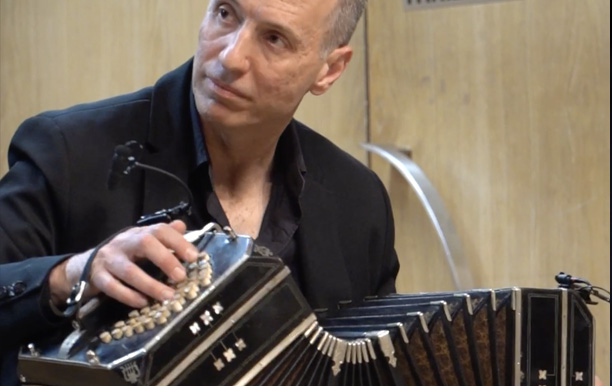
One of the characteristics that distinguishes tango from many other dance music genres is that it is performed primarily with acoustic instruments. Tango orchestras do not typically include modern rhythm instruments such as drum sets, electric bass guitars, or synthesizers. Instead, they rely on acoustic instruments such as double bass, piano, bandoneon, violin, and occasionally classical guitar.
For a dancer, one of the most important references in music is a regularly repeating rhythmic pattern. These rhythms activate movement, convey energy, and help the dancer find their way within the music. In rock music and many Latin music genres, this role is performed by percussion instruments such as drums, congas, and bongos. These instruments make the rhythm highly explicit and provide dancers with a strong point of reference.
In tango music, however, things work a little differently. Since there is no true percussion section in the orchestra, acoustic instruments must take on that role. This is precisely where marcatos come into play.
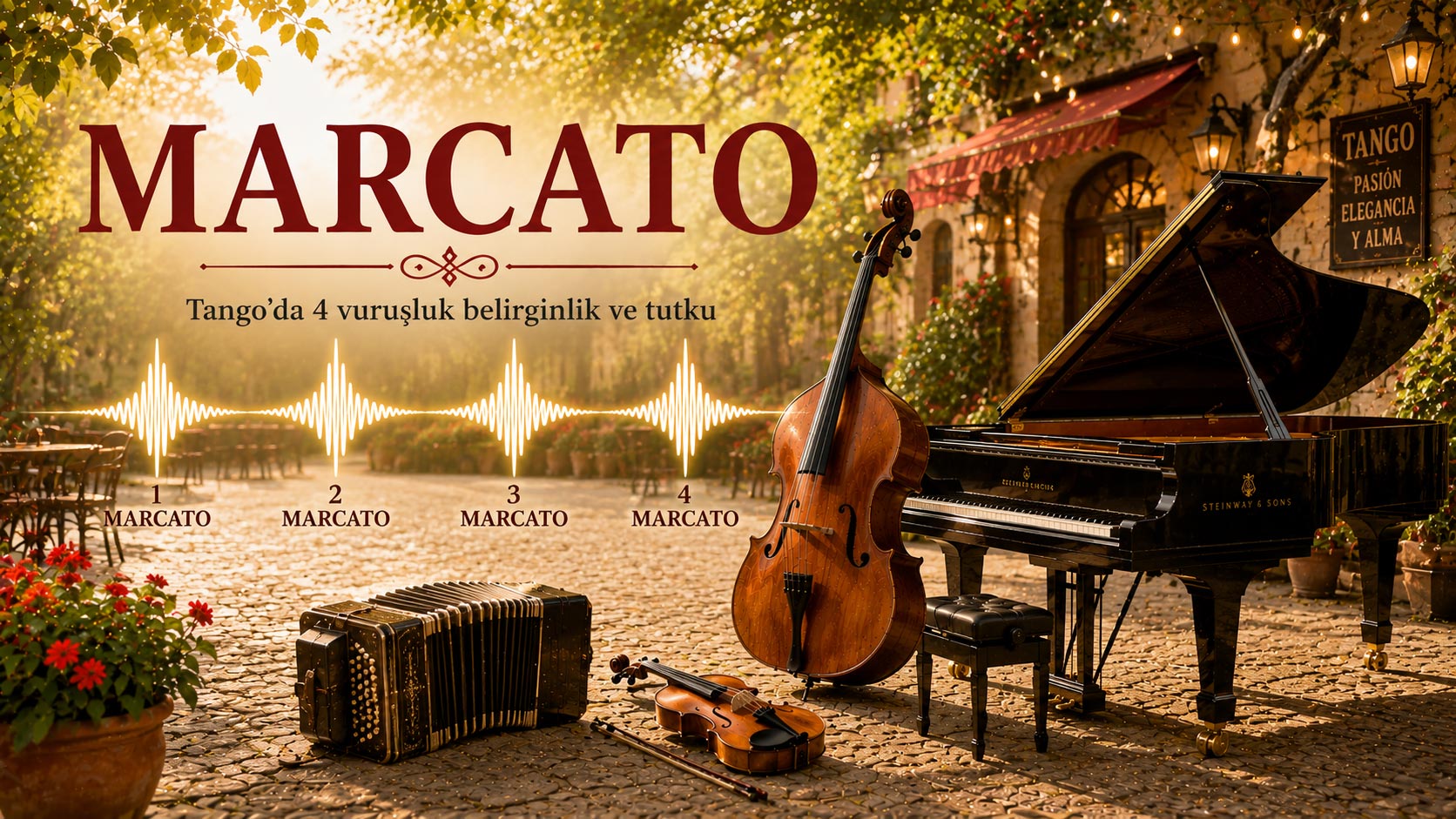
The word marcato literally means to emphasize a sound or note distinctly. In tango music, however, it represents something more specific. We use the term marcato to describe the short, powerful, and high-energy accents created collectively by the rhythm section, particularly the double bass, piano, and bandoneon.
In fact, when we dance, this is often exactly what we are following without even realizing it.
Marcatos repeat at regular intervals. They function almost like an invisible metronome. They create a sense of percussion within the music, help dancers maintain their timing, and prevent them from getting lost while dancing. For this reason, marcatos are often among the first signals we perceive when listening to tango music.
Four-Beat Tango and Marcato Patterns
Most tangos are written in four-beat meter, meaning that each measure contains four basic beats.
Marcatos can be placed on different beats within the measure, and their placement directly influences the character of the dance.
In tango music, there are two primary marcato patterns that we encounter most frequently.
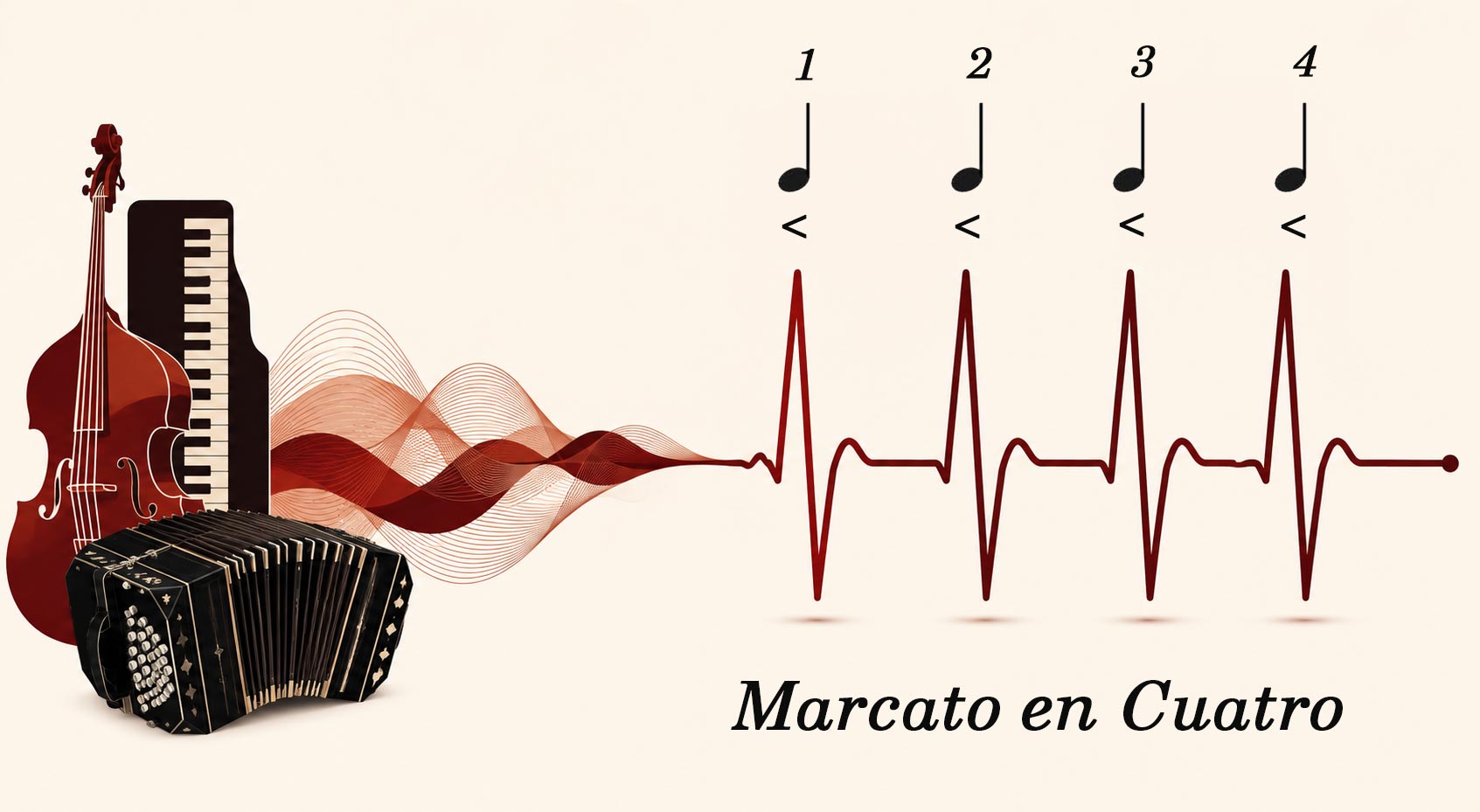
Marcato en Cuatro
The first and most obvious pattern is Marcato en Cuatro, or four-beat marcato.
In this structure, all four beats within the measure are strongly accented. Each beat is heard clearly, briefly, and energetically. The result is a rhythmic structure that can feel almost as explicit as a drum pattern.
From a dancer's perspective, this creates a powerful sense of forward-moving energy. Steps tend to be taken more frequently, the sensation of walking becomes prominent, and the dance acquires a more rhythmic character.
Many recordings by D'Arienzo are excellent examples of this energetic feeling.
Marcato en Dos
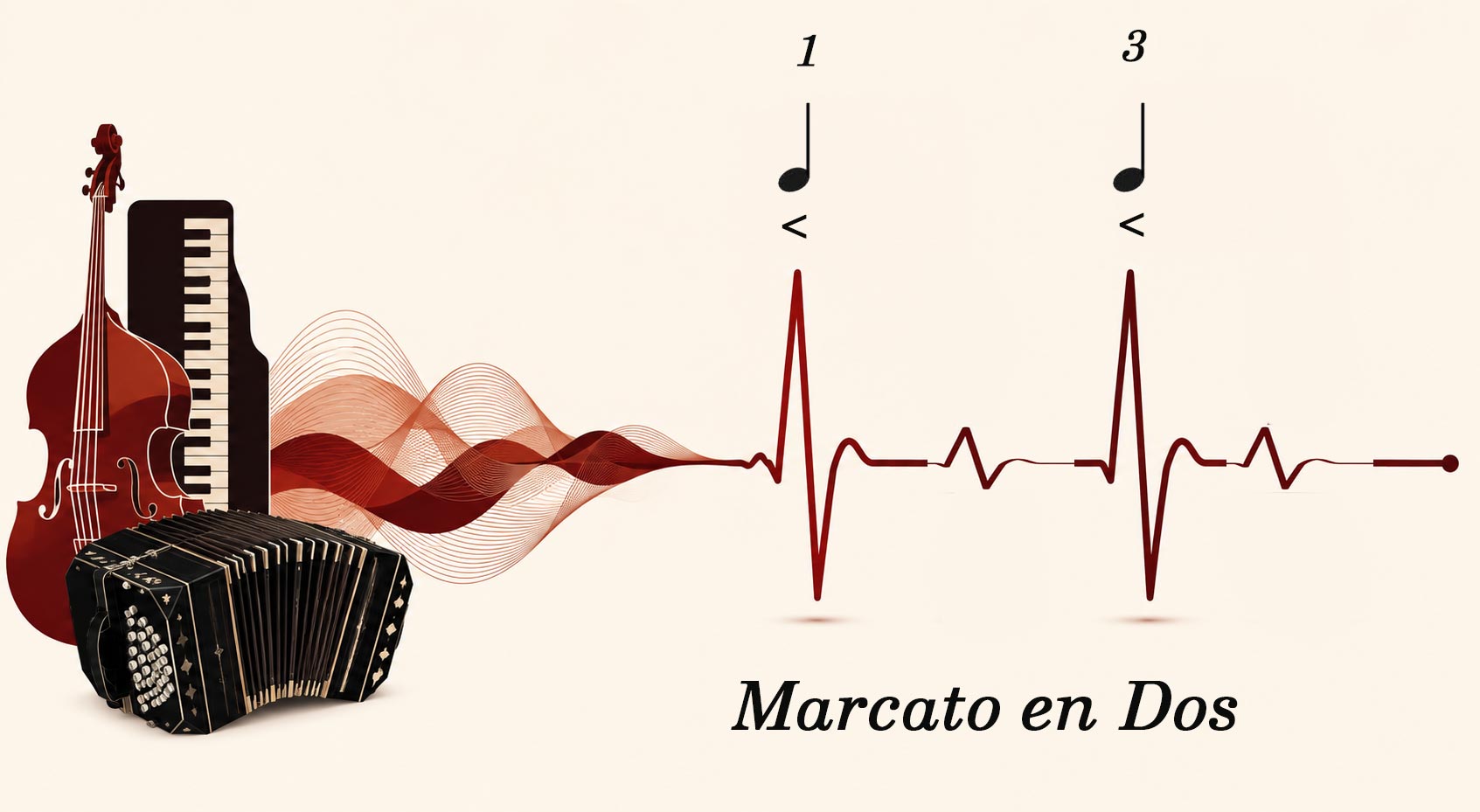
The second common pattern is Marcato en Dos, or two-beat marcato.
In this structure, only the first and third beats of the measure are strongly accented. The second and fourth beats are either heard very softly or remain almost entirely in the background.
To put it simply:
- In Marcato en Cuatro, beats 1, 2, 3, and 4 are all clearly audible.
- In Marcato en Dos, the primary accents are on beats 1 and 3, while beats 2 and 4 play only a supporting role.
As a result, the music feels different. Rhythmic pressure decreases, while the melodic structure becomes more apparent.
For dancers, this often translates into longer steps, calmer movement, and more space to follow the melody.
What Does This Mean for a Dancer?
Marcato patterns are not merely a musical technique. They also provide important strategic information for dancers.
Four-beat marcatos generally suggest a dance that is more energetic, more rhythmic, and more continuously driven forward. The dancer feels the rhythmic engine of the music and builds movement upon that energy.
With two-beat marcatos, however, the rhythm recedes somewhat into the background. Within this additional space, melodies, musical phrases, and emotional nuances become more visible. As a result, the dance often becomes more elegant, more fluid, and more melodic.
For this reason, one of the first things we should do when stepping onto the dance floor is listen carefully to the rhythmic signals the orchestra is giving us.
If we hear a strong Marcato en Cuatro, we can immediately plan for a more rhythmic and energetic dance. If the music is dominated by Marcato en Dos, we can create more space for melodies and for the emotional flow of the music.
Orchestras and the Use of Marcato
Classical-era orchestras such as D'Arienzo and Di Sarli can generally be thought of as orchestras that maintain relatively stable marcato structures. For this reason, they are often easier for dancers to follow.
The situation changes, however, when we move to later orchestras such as Troilo and especially Pugliese. These orchestras frequently use tempo changes, marcato variations, and multiple rhythmic layers, creating much broader possibilities for interpretation.
For this reason, dancers who are beginning to study tango musicality may benefit from first becoming familiar with the clearer rhythmic structures of the Guardia Vieja and Guardia Nueva periods. Once they learn to hear and interpret marcatos, entering the more complex rhythmic world of orchestras such as Troilo and Pugliese becomes much easier.
The next step is not only to hear these marcatos but also to feel them in our bodies and consciously reflect them in our dancing. In tango, following the music often begins not with following the melody, but with following the engine of the rhythm—the marcatos.
Back to Blog