Bandoneon & Piano Self Duet
Chiquilín de Bachín: A Bandoneon & Piano Self Duet
Chiquilín de Bachín is one of Astor Piazzolla's most touching and poetic compositions. Written in collaboration with lyricist Horacio Ferrer, the piece was inspired by a young street child in Buenos Aires and has become one of the most beloved works in the tango repertoire.
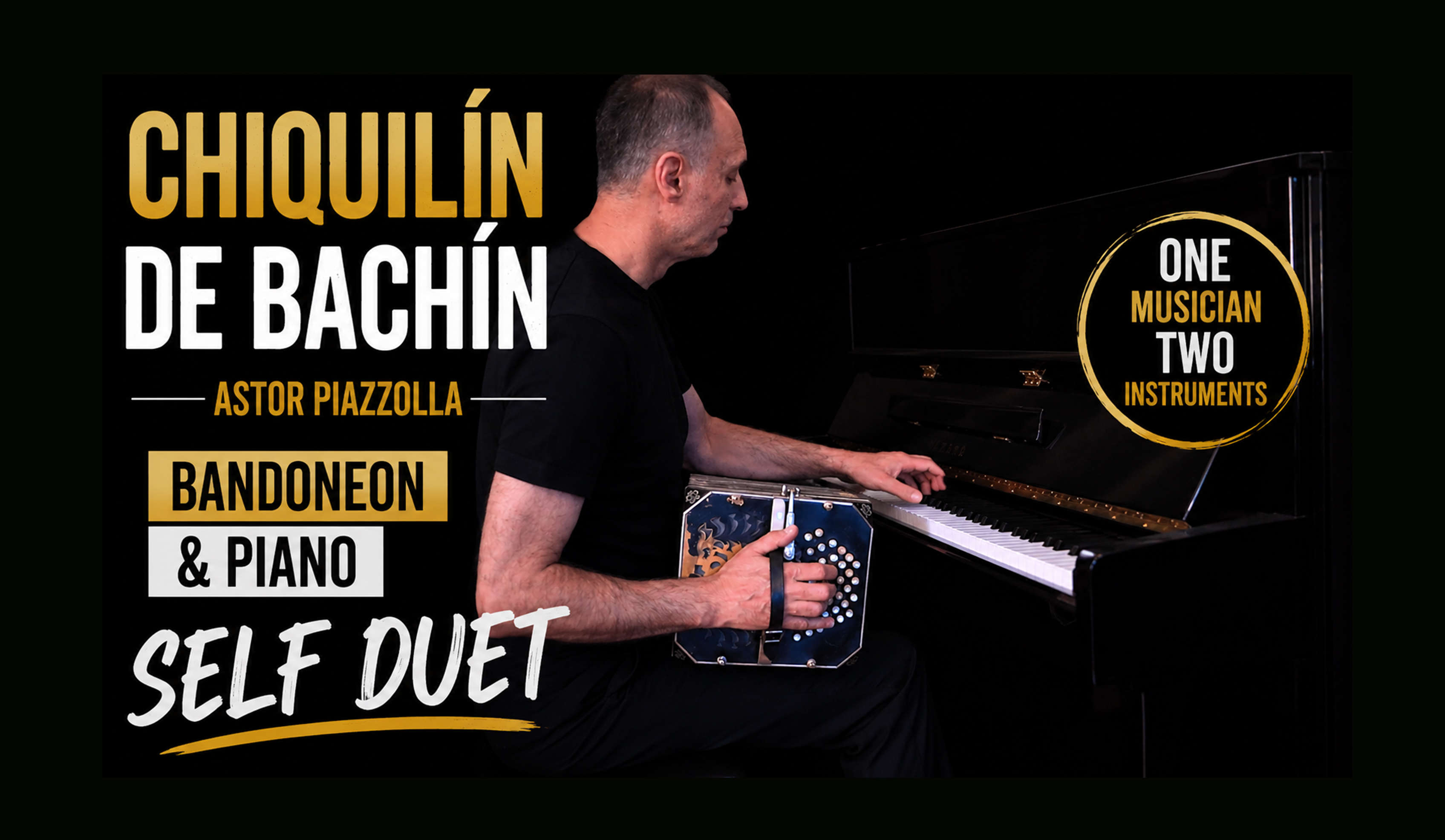
For this performance, I chose to approach Chiquilín de Bachín in an unconventional way. Instead of performing it with another musician, I play both the bandoneon and the piano simultaneously, creating what I call a "Self Duet."
In a traditional duet, two musicians share the responsibility of shaping the music. One may carry the melody while the other provides harmony, rhythm, or counterpoint. In a self duet, however, both musical roles must be managed by a single performer at the same time.
This becomes particularly challenging when the two instruments involved are the bandoneon and the piano.
The piano is one of the most visually organized instruments in the world. Notes are arranged in a clear and predictable linear pattern across the keyboard. The bandoneon, by contrast, follows a completely different logic. The right-hand and left-hand sides each have their own independent button layouts. In addition, many bandoneons produce different notes when the bellows are opening and closing. As a result, the player effectively works with four different keyboard systems rather than one.
Playing both instruments simultaneously therefore requires more than simply mastering two instruments. It demands the ability to operate two fundamentally different musical and physical systems at the same time. On one side there is the structured, linear logic of the piano keyboard; on the other, the intricate and multidimensional layout of the bandoneon.
Yet the technical challenge is only part of the story.
The greater challenge is preserving the natural flow of the music. A compelling performance is not created merely by playing the correct notes. Musical phrasing, dynamics, articulation, timing, balance, and expression are equally important. When all attention is consumed by technical coordination, the music can easily become mechanical and lose its emotional depth.
For this reason, the goal of a self duet is not simply to play two instruments simultaneously. The real objective is to transform them into a single musical voice. Rather than hearing two separate instruments, I hope listeners experience one coherent musical narrative.
The lyrical and introspective character of Chiquilín de Bachín makes it especially suitable for this approach. The warm, human-like voice of the bandoneon blends naturally with the harmonic richness of the piano, creating the fragile and deeply expressive atmosphere that I have always admired in Piazzolla's music.
I hope you enjoy this interpretation of Chiquilín de Bachín performed as a Bandoneon & Piano Self Duet.
Astor Piazzolla – Chiquilín de Bachín
Bandoneon & Piano Self Duet
Performed by Burak Şendağ
Video
Back to Blog